05
PISPL Team | June 11, 2026 | 262
In the evolving digital landscape, understanding the critical differences between subtitling and captioning is no longer optional for businesses. As 2026 approaches, regulatory pressures, user expectations, and the pursuit of broader audience engagement necessitate a strategic approach to video accessibility. This article delves into why this distinction matters for your enterprise.
Subtitling vs Captioning The Strategic Imperative for Businesses by 2026
Subtitling vs Captioning The Strategic Imperative for Businesses by 2026
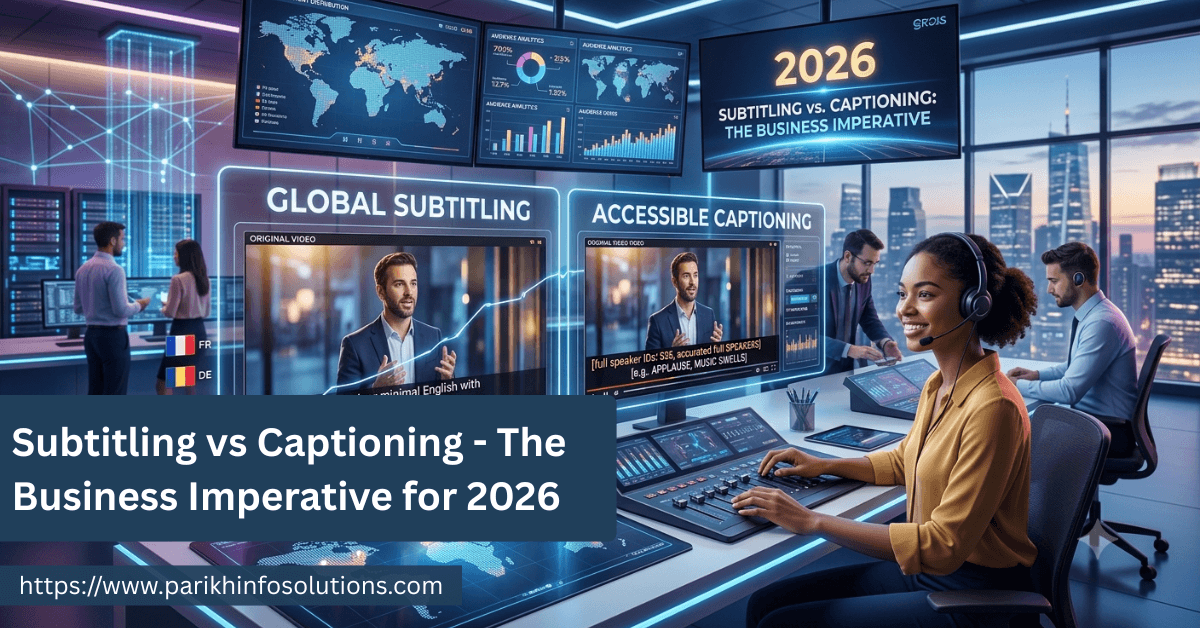
The digital landscape, ever-evolving, increasingly demands that businesses reconsider their fundamental approach to video content. A crucial element of this reevaluation involves understanding the nuanced yet profound differences between subtitles and captions, and recognizing their strategic importance as we accelerate towards 2026. Fundamentally, subtitles are textual representations of spoken dialogue in video content, primarily serving to translate foreign language audio for viewers who can hear but do not understand the original language. Their purpose is to bridge linguistic gaps, making content accessible to a broader, international audience. In contrast, captions are comprehensive textual representations of all audio elements within a video, encompassing not only dialogue but also crucial sound effects, speaker identification, and music cues. Their primary audience is viewers who cannot hear the audio, such as the deaf or hard-of-hearing community, ensuring full comprehension and an equitable viewing experience. Further differentiation exists within captioning itself: open captions are embedded directly into the video stream, meaning they are always visible and cannot be turned off by the viewer. Conversely, closed captions offer viewers flexibility, as they can be toggled on or off according to individual preference, typically via a button on the video player. While distinct in their primary function and target audience, both subtitling and captioning serve complementary roles in significantly enhancing content accessibility and expanding its overall reach.
The profound business implications of these distinctions will only grow in magnitude leading up to and beyond 2026. Robust implementation of both subtitling and captioning directly addresses several critical areas for any forward-thinking enterprise.
The evolving technological landscape is both an enabler and a challenge for these practices by 2026. Advancements in Artificial Intelligence (AI) and Machine Learning (ML) have revolutionized automated transcription and translation, offering undeniable benefits in terms of speed and cost reduction. These tools can generate initial drafts rapidly, democratizing access to basic captioning. However, it is critical to highlight their current limitations: AI often struggles with specialized terminology, accurately identifying and distinguishing multiple speakers, capturing nuances of tone, sarcasm, or cultural idioms, and handling complex soundscapes. Consequently, the continued need for meticulous human review and quality assurance remains paramount to ensure accuracy, context, and brand integrity. Furthermore, the increasing demand for real-time captioning for live events – from webinars to broadcast news – is driving innovation in low-latency AI and human-assisted transcription technologies. User expectations for personalization in caption and subtitle display (e.g., control over font, size, and color) are also rising, making it essential for content management systems to offer integrated workflows that support dynamic, user-configurable text overlays.
To effectively implement subtitling and captioning practices by 2026, businesses must adopt a strategic approach. This includes developing clear internal policies that mandate accessibility standards for all video content, investing in reliable captioning and subtitling tools and services (whether in-house or outsourced), and establishing rigorous quality control measures to ensure accuracy and consistency. Furthermore, formulating a comprehensive multi-language content strategy that integrates translation and localization from the outset, rather than as an afterthought, will be crucial. Finally, allocating appropriate budgets for these efforts is not merely an expense, but an essential investment for future business growth, sustained competitive advantage, and adherence to evolving global standards.
Conclusions
By 2026, businesses must master the distinction between subtitling and captioning for compliance, market reach, and genuine inclusivity. Strategically implementing open and closed captions, and providing accurate subtitles, unlocks new audiences and enhances user experience. Embracing these practices ensures content resonates globally and ethically, securing future business success in a competitive digital landscape.
 Author

© Parikh info Solutions Pvt. Ltd.
2026 All Rights Reserved
Find us on: